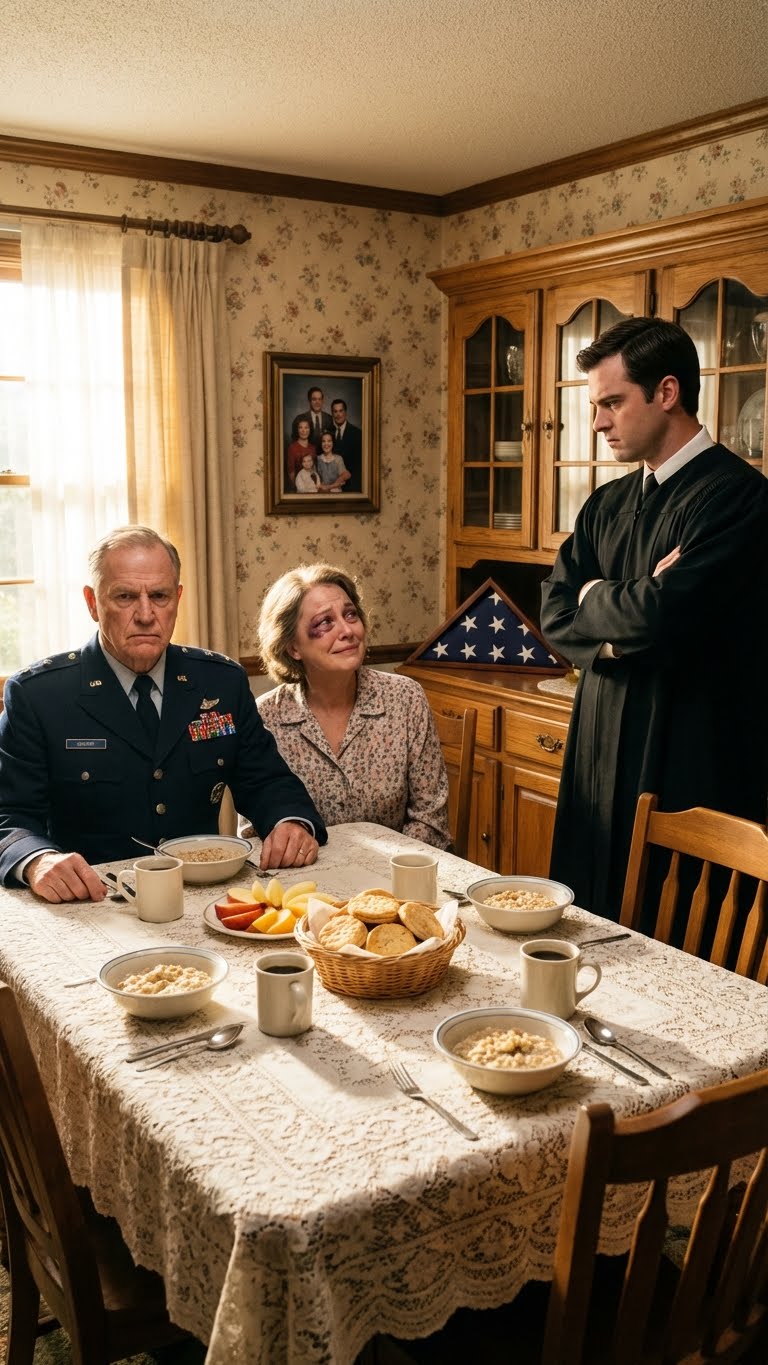
“Oh, of course. Now that I’m in a good mood, you’re going to abandon me. But when I’m down, you just sit there with that martyr face of yours, looking at me like I’m a worm, right?”
He stood up and came toward me. He didn’t touch me, but he stood in front of me, blocking my way. And he started talking, low, and it was worse than the yelling.
“You like this, don’t you, Mom? You like seeing me suffer. It makes you feel superior. The holy widow who sacrificed everything for her ungrateful son. Is that the story you tell yourself? Is that what helps you sleep at night?”
He just stood there, spitting that poison at me for nearly ten minutes, and I just stood there, unable to move, just taking it. I felt myself shrinking, getting smaller, weaker with every word he said.
When he finally got tired and moved out of my way, I went up the stairs, shaking. I got to my room, locked the door, and sat on the edge of my bed. And for the first time in a long, long time, I cried.
I cried silently, muffling the sobs in my pillow so he wouldn’t have the satisfaction of hearing me.
The beeping of the coffee maker brought me back to the early morning. The coffee was ready. I stood up, the pain in my back reminding me that the violence of that night had been different. He had crossed a line, a physical line. He had touched me in anger, and the slap, that slap wasn’t just to my face. It was to my soul.
I opened the cupboard and took out my best china, the dinner set I got for my wedding with the little hand-painted blue flowers. I rarely used it. It was for special occasions, and this, I decided, was the most special occasion of all.
It was the day of my liberation.
I set the table with meticulous care. The lace tablecloth, the plates, the silver cutlery that I’d polished just last week. I put a small vase with a white camellia from my garden in the center.
The table was beautiful, a scene of peace and order.
A perfect lie.
As I put the cups in their places, I thought about the storm outside, the hard rain, the howling wind. It felt like nature was mirroring the turmoil inside me. But for the first time in a long time, I wasn’t afraid of the storm—not the one outside and not the one sleeping upstairs—because I knew that when the sun came up, my own personal storm was finally going to break.
I looked at the clock: five forty-five. I still had time. Time to bake the last batch of biscuits and time to make the phone calls that would change everything.
The house was about to wake up, and justice, my dear, was going to be served hot, right alongside the coffee.
It was exactly three fifteen in the morning when the key scraped in the front door lock.
I know the exact time because the grandfather clock had just chimed three o’clock, and I’d counted every one of the fifteen ticks that came after.
I was sitting in my rocking chair in the kitchen, wrapped in my bathrobe. It was a flannel bathrobe, real thick and plush, a deep navy blue. I bought it last winter because my joints ache something fierce with the Savannah damp and cold. I remember thinking when the package arrived that it felt like a hug, and that morning, I was clutching it around me like it was a shield, trying to find some kind of warmth, some kind of protection from the cold that was coming from inside me.
The door flew open with a bang, like it had been kicked, and slammed against the hallway wall. The sound echoed through the silent house.
My heart jumped and started beating a fast, frantic rhythm in my chest.
I held my breath.
I waited.
Jeremiah came in, a dark silhouette against the dim streetlight. The rain had gotten heavier and he was soaked to the bone. Water dripped from his hair, from his coat, making a dark puddle on my wood floor. He looked like a wounded, angry animal that had sought shelter from the storm.
He just stood there for a moment, his breathing heavy, almost a growl, and then he moved.
With a sudden fury, he pulled the bundle of keys from his pocket and threw it with all his might toward the little hall table.
I heard the sharp shattering sound of ceramic. My vase, my blue vase, that had belonged to my grandmother. The sound of that heirloom breaking was like the sound of my own heart splitting in two.
A dry sob rose in my throat, but I forced it down. Crying now? No. Crying would be a luxury and it would be dangerous.
He didn’t seem to care what he’d broken. He kicked the door shut and came walking toward the kitchen. His steps were heavy, unsteady. The smell hit me first, a sharp, sour smell of cheap bourbon mixed with the smell of rain and pure rage.
He stopped in the kitchen doorway, his big body filling the frame. The only light was the one over the stove, a yellowish light that cast long, frightening shadows. His eyes found me in the dimness.
“What is it, Mom?” His voice was a slur, thick and pasty from the drink. “You sitting there in the dark like a ghost, waiting up to give me a lecture, to judge me?”
I didn’t move in my chair. I kept my hands clamped on the arms of the rocker, feeling the worn wood under my fingers. I knew from experience that any move I made could be seen as a provocation. Silence was my only defense.
“Answer me,” he suddenly yelled, and his voice echoed off the pots hanging on the wall. “Are you praying for my lost soul or are you more worried about your damn old vase I broke?”
The mention of the vase, the coldness with which he spoke of that object he knew meant so much to me, gave me a courage I didn’t know I had.
I stopped rocking.
Slowly, with what little dignity I had left, I stood up. My back popped. I looked him straight in the eye, trying to find, deep down, any trace of my boy.
“Jeremiah, son.” My voice came out steadier than I expected. “I’m not going to lecture you. I just want you to go get some rest. You’re all wet. You’ll catch a cold. We can talk in the morning when you’re feeling better.”
It was the wrong thing to say.
I should have known. Trying to be reasonable with a man who has lost his reason is like trying to put out a fire with a thimble of water.
My words, my calm, my motherly concern—to him, they sounded like an insult, like I was treating him like a child.
His face twisted into a mask of fury.
“Don’t you tell me what to do,” he roared, taking another step toward me. He pointed a trembling finger at my face. “You don’t understand anything. You never have. You live in your little fairy-tale world with your old junk, your memories, Daddy’s ghost. The real world is out there, Mom, and it’s eating me alive. And you, you just sit there and tell me to go to sleep.”
“That’s not it, son,” I started to say, holding up a hand in a gesture of peace.
“Shut up.”
His shout was so violent I flinched, and then he came at me.
It wasn’t a shove. It was an assault.
He grabbed my upper arms with a strength I never imagined he had, a strength born of frustration and alcohol. His fingers were like steel talons digging into the thin skin of my arms. The pain was immediate and searing.
“Jeremiah, stop. Please, you’re hurting me,” I cried out, and for the first time, my voice broke with panic.
But he wasn’t listening. His eyes were glazed over, focused on something only he could see. He started to shake me back and forth violently. My body, frail and old, swung like a rag doll’s. My head snapped back and forth. My glasses flew off my face and landed on the floor with a soft thud. The world around me became a blur of lights and shadows. The kitchen shelves, the refrigerator, the table, everything was spinning.
“You only care about things, about this house, about him,” he was screaming, and with every word, he shook me harder. “I’m nothing to you. I never was. I’m just a burden, the failure son of the great Robert Hayes.”
I was getting dizzy. The air wouldn’t come into my lungs. I tried to pull away, but it was useless. He was so much stronger.
At some point during the violent rocking, my feet lost contact with the floor, and that’s when he threw me.
It wasn’t a push. He threw me.
My body flew backward toward the wall where my grandmother’s china cabinet stood. Time seemed to slow down. I saw the dark wood of the cabinet getting closer, as if in slow motion. There was no time to protect myself, to put my arms out.
The impact was brutal.
First, my back hit with a deep, hollow thud against the solid wood. I felt like my spine was going to snap in two. The blow knocked the wind out of me in a single painful gasp, and in the same instant, my head, carried by the momentum, whipped to the side and cracked hard against the corner of the cabinet, an explosion of white light and sharp pain behind my eyes.
The sound was a dry snap, a crack that seemed to echo inside my skull. The world went white for a second. A loud ringing, like a million bees, filled my ears.
I slid down the wall, my legs like jelly, and collapsed to the floor.
The pain was overwhelming, a throbbing pain in the back of my head, a sharp pain in my back, a burning pain in my arms where he had held me. I was stunned, confused. I tried to focus my eyes. I saw the kitchen spinning, the lights distorting, and then I saw him.
He was standing a few feet away, his chest heaving, his fists clenched. He was looking down at me on the floor with an unreadable expression, and I thought, It’s over. He’ll stop now. He’ll realize what he’s done.
But no.
He took a step toward me. I flinched instinctively, trying to shield myself with my arms, and his hand came, open, fast, violent.
The slap cracked through the air, an ugly, wet sound. It caught me square across the face. My head was thrown to the side from the impact. I felt the skin of my lip tear against my own teeth, and the hot, salty taste of blood filled my mouth.
And that was it, the final act.
He stood there over me for a few more seconds. His breathing was still heavy. I looked up at him from the floor. My son, the baby I carried in my arms, the boy I taught to walk, to talk, to pray—and I didn’t recognize him.
The man in front of me with his hate-filled eyes was a stranger, an intruder, a monster.
And then, without another word, as if he’d finally expelled all the poison he was carrying, he turned. He turned his back on his mother, lying bruised and bleeding on the kitchen floor, and he went upstairs.
I heard his steps, heavy and slow, in the upstairs hallway. And then the final sound, the slam of his bedroom door, a sound that sealed my fate and his, the sound that began the longest morning of my life.
The silence that settled in the kitchen after his bedroom door slammed shut was the heaviest thing I have ever felt in my life.
It wasn’t a peaceful silence. It was a vacuum, a silence of shock, the kind of quiet that comes after an explosion when everything around you is destroyed and the dust hasn’t settled yet.
The only thing I could hear was the sound of the rain outside, relentless, and the sharp ringing inside my own head.
I lay there on the floor for what felt like an eternity. My whole body ached, every muscle, every bone. The back of my head throbbed with a steady, nauseating rhythm. The taste of blood in my mouth was strong, and I could feel a warm trickle running down my chin.
I was curled up, my arms wrapped around my knees like a frightened child, and for a moment, that’s all I was—scared, terrified, a sixty-eight-year-old woman alone, hurt on the floor of her own home by the person she loved most in the world.
The tears came, silent, hot. They ran down my face and mixed with the blood on my chin. They weren’t tears of anger. They were tears of pure, absolute grief, a grief that wasn’t just physical. It was the pain of betrayal, the pain of looking at the fruit of your womb and seeing a stranger, the pain of realizing that the love you gave, the life you sacrificed, had produced this: a man capable of raising his hand to his own mother.
I thought of my Robert.
What would he say if he saw me like this?
Robert was a gentle man, but a firm one. He never raised his voice to me in thirty years of marriage. He treated his own mother, a small, frail woman, like she was a queen made of crystal.
If he saw what Jeremiah had become, his heart would break all over again, wherever he was.
The image of my husband gave me a spark of strength. I couldn’t just lie here on the floor crying. Robert wouldn’t have wanted that. My mother wouldn’t have wanted that. My grandmother, who faced things I can’t even imagine, certainly wouldn’t have wanted that.
I’m made of stronger stuff. I had just forgotten.
With a groan of pain, I pushed myself up using the leg of the kitchen table for support. The cold, solid wood gave me an anchor. Slowly, inch by inch, I got to my feet. My legs were shaking so badly I thought I’d fall again. I held onto the edge of the table, breathing deeply, trying to fight off the dizziness. The whole kitchen seemed to be swaying.
When I felt a little steadier, I walked slowly, holding onto the furniture, to the little half bath under the stairs. Every step was an agony. When I got there, I reached out a trembling hand and flipped on the light, and then I looked in the mirror.
The yellow light was merciless.
The woman staring back at me was broken. My gray hair, which I always keep in a neat bun, was loose and disheveled, strands stuck to the sweat on my forehead. My face, my left cheek, was red and swollen, and the skin around my eye was already starting to darken, a nasty purple bruise forming. And my lip, it was split, puffy, the dried blood forming a dark crust in the corner of my mouth.
I raised my hand and touched the bruised cheek with my fingertips. The skin was hot, tender, and as I touched it, I didn’t just feel the physical pain. I felt the humiliation, the shame. That mark on my face wasn’t just a bruise. It was the visible proof of my failure, the failure of a mother who didn’t see the monster growing, the failure of a woman who let fear silence her.
And it was right there, looking at that mark, that the sadness began to turn into something else, something cold, hard—an anger.
But it wasn’t a hot, explosive anger like Jeremiah’s. It was a cold, calculating anger, an anger that didn’t scream.
It whispered.
And what it whispered was, Never again.
I turned on the cold water tap. I cupped my hands and splashed the icy water on my face once, twice, three times. The water stung my cut lip, but it was a good pain, a pain that woke me up. I washed away the blood, the sweat, the tears. I dried my face with a small towel, patting gently at the sore area, and I looked in the mirror again.
The broken woman was gone.
The woman staring back now had steel in her eyes. There was pain in them, yes, a deep pain that might never go away, but there was no more fear. The fear had been burned away by that cold anger. In its place was resolve, a deadly calm, the calm of someone who has hit rock bottom and found that the ground was solid stone and you could push off of it to go back up.
I thought about my options.
I could do nothing. In the morning, I’d put on some makeup to hide the bruise. I’d say I fell. Jeremiah might apologize with that weepy, sorry little boy voice he used. I’d pretend to accept it and we’d go back to our routine of walking on eggshells until the next explosion, and the next, and the next, until when?
Until he pushed me harder?
Until my head hit a corner in a way that I didn’t get up from?
No. That option was dead and buried.
I could pack a bag and leave, call my sister Paulette in Atlanta, ask for shelter, abandon my home, my memories, my life, leave Jeremiah here to drown on his own in his bitterness and his liquor. But this house, this house was mine. It was my sweat, my husband’s sweat, that paid for it.
Why should I be the one to run?
I had done nothing wrong.
I would not be the fugitive.
So that only left the third option, the hardest one, the most painful one, the only one that felt like a real solution. The only one that could maybe save my life and, who knows, in some twisted, terrible way, his life too.
I left the half bath. The kitchen was still a mess. My glasses were on the floor near the rocking chair. I picked them up. One of the lenses was cracked. I put them on anyway. The crack in the lens seemed like a symbol of how I saw the world now.
Everything was broken.
I walked through the dark living room. The ticking of the grandfather clock seemed louder now, marking the rhythm of my decision. I went to the phone, an old rotary phone that sits on a little table in the hall, but I didn’t use it. I went to the kitchen and got the cordless phone, a more modern handset I bought a few years back. One with big backlit buttons, you know? One of those for older folks to make dialing easier. I bought it because my fingers sometimes get stiff from arthritis.
I never thought I’d be so grateful for those big buttons because my hands, in that moment, were shaking. Not from fear, but from a nervous determination.
I took the phone into the dining room. I sat in my chair at the head of the table, the same table where, in a few hours, everything would happen. I took a deep breath and I made the first call.
The night was still dark, but my mind had never been so clear. The plan began to form piece by piece. It wasn’t a plan for revenge.
It was a plan for survival.
I didn’t want to destroy my son. I needed to stop the monster he’d become, and if to do that I had to break his heart and my own into a thousand pieces, then so be it.
Some hearts need to be broken so the light can get in.
I grabbed an item I’d thought about using earlier but gave up on: a high-coverage concealer. I’d bought it online after seeing an ad that promised to cover any imperfection. It was from a fancy brand in a little gold tube. I bought it thinking I’d hide my age spots, the dark circles from sleepless nights.
When I looked in the mirror after the assault, my first instinct was to think, Tomorrow, I’m going to need a lot of this.
But now, looking at the little gold tube in my hand, I threw it in the drawer with force.
No more covering up.
No more hiding.
The truth, as ugly as it was, needed to be seen.
The world needed to see it.
And more importantly, Jeremiah needed to face, in the light of day, the mark he had left on me. The shame would no longer be mine alone. From that moment on, I was going to share it with him.
I was sitting in the darkness of the dining room, the cordless phone heavy in my hand. The silence of the house was almost absolute, broken only by the steady sound of the rain and the electric hum of the refrigerator in the kitchen.
I looked at the illuminated buttons on the handset. Each number seemed like a challenge. To dial meant to make it all real. It meant crossing a point of no return.
For a second, the mother inside me, the one who gave birth, who nursed, who stayed up all night with fevers, hesitated. A weak voice whispered in the back of my mind, That’s your boy, Gwen, your only child. You can’t do this to him.
But then the pain in my head throbbed sharp, and the taste of blood returned to my mouth. The hesitation vanished like smoke.
That man upstairs, snoring in the room I’d so lovingly decorated, was not my boy anymore. My boy wouldn’t throw me against a cabinet. My boy wouldn’t raise a hand to me.
That man was a dangerous stranger, and I needed to protect myself from him.
I took a deep breath and dialed the first number. My fingers trembled a bit, but I dialed with a firm press. The sound of the ringing, that ring, ring, sounded absurdly loud in the quiet house.
It was almost four in the morning.
I was calling to wake up a seventy-three-year-old retired federal judge.
On the other end, on the third ring, a sleepy but instantly sharp and authoritative voice answered.
“Hello?”
“Bernice? It’s me, Gwen. I’m so sorry to call at this hour, my dear.”
There was a pause. I heard her stirring, the sound of fabric. The sleepiness in her voice vanished, replaced by immediate concern.
“Gwendolyn? For heaven’s sake, what’s happened? Are you all right? Is it Jeremiah?”
Mrs. Bernice Johnson, my neighbor for over forty years. We’d watched our children grow up together, buried our husbands within months of each other, shared countless cups of tea on the porch. But Bernice was more than a friend. Before she retired, she was one of the most respected judges in Georgia, a Black woman who broke barriers, who faced the system and won. Her mind was as sharp as a razor, and her presence commanded a respect few people could.
If there was anyone in the world who would understand the complexity of my situation, the mix of love and terror, it would be her.
I swallowed hard. The shame burned my throat.
“I… I need you, Bernice. It happened again, but this time it was worse.”
I didn’t need to say anything else.
I heard her sigh on the other end, a heavy sigh, not of surprise, but of deep sadness, of confirmation.
“Did he hurt you, Gwen?”
The tears welled up in my eyes again, but my voice stayed steady.
“Yes.”
“Call the police,” she said without hesitation. It wasn’t a question. It was a command.
“I’m going to,” I answered. “But first, I need to ask you something. I know it’s a lot to ask, but could you come over for breakfast at eight o’clock sharp?”
Another pause. I could almost feel the gears of that brilliant mind turning. She didn’t ask why I wanted to serve breakfast in a situation like this. She understood. She understood this wasn’t about food. It was about bearing witness. It was about authority.
“Gwen, I’m not coming for breakfast.” Her voice turned hard as steel. “I’m coming to hold court. Where is your boy now?”
“Sleeping, drunk, in his room,” I whispered.
“Good,” she said. “Let him sleep. Don’t talk to him. Don’t make a sound. Just do what you have to do. I’ll be there at eight. And Gwen?”
“Yes?”
